

What is Elicit AI?

Elicit AI is an AI research assistant that helps with research tasks like finding relevant papers, summarizing, and brainstorming. Elicit AI is mainly used by researchers and students but can literally be used by anyone for anything. With its powerful AI-driven capabilities, Elicit AI simplifies the research process, saving users time and effort while boosting productivity, or at least that’s what it claims.
In this comprehensive review of Elicit AI, we will delve into its standout features, explore diverse use cases, assess its limitations, and provide insights into its pricing structure and alternatives. Whether you’re a student embarking on a thesis, a researcher looking to streamline your workflow, or a professional needing quick access to reliable data, this Elicit AI review will help you determine if this is the right tool for your needs.

Elicit AI Use Cases
The fact of the matter is research surrounds us more than ever before. According to the National Science Foundation, in 2022, the U.S. spent an estimated $885.6 billion on research and development (R&D), which was a 12% increase from 2021. Additionally, AI technologies like large language models are showing growing signs of presence in research papers. For example, according to Stanford University’s research, 17.5% of computer science papers have AI generated content.
The point is that Research and AI are two constantly intersecting fields opening up a plethora of opportunities. Let’s check out three popular use cases for Elicit AI.
1. Literature Review

Elicit AI’s biggest feature is its ability to rapidly identify research papers and evidence just from short text prompts. Elicit AI’s powerful capabilities allows for it to search through huge databases and repositories. This AI software comes in especially handy not just because of it’s reliability but also because of the tremendous amounts of time it saves.
2. Academic Research

Elicit AI is revolutionizing academic research by all. This powerful AI software tool helps researchers quickly sift through peer-reviewed papers, identify relevant studies, and summarize findings in minutes. It’s ideal for students, teachers, and professors looking to enhance productivity, efficiency, and accuracy in their research.
3. Policy Making/Argument

Thanks to it’s advanced semantic features, Elicit AI can aid in evidence-based policy making by synthesizing research findings relevant to specific policy questions. Additionally, the practices of arguing and debating require evidence enriched arguments. For me and for many debaters/speakers nation-wide, tools like Elicit AI help so much by bringing reliable evidence straight to your finger-tips.
Pricing Plans and Features
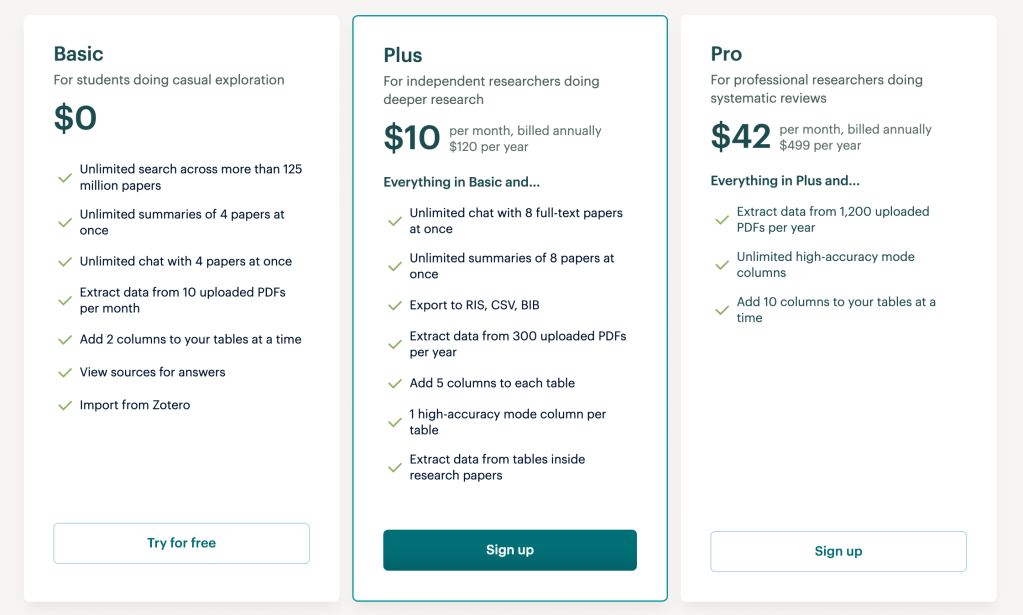
Elicit AI offers three plans: Basic, Plus, and Pro. Let’s look at each plan in more depth.
Basic
Elicit AI’s Basic plan stands out as one of the most generous free offerings available in the market today. With this plan, users gain unlimited search capabilities, unlimited summaries, and the ability to chat with up to four pages simultaneously. Additionally, you can extract data from 10 uploaded PDFs per month and access all source materials with ease. While there are several other useful features included, these core features make the Basic plan an exceptional choice for people looking to not break their bank.
Plus
Elicit AI’s Plus plan is priced at just $10 per month when billed annually. This plan includes everything from the Basic plan plus unlimited chat and unlimited summaries for up to 8 full-text papers at once. Additionally, the Plus plan allows you to export research data to RIS, CSV, or BIB formats. Other features include the ability to extract data from 300 uploaded PDFs and the ability to extract from tables inside research papers. The Plus plan is for people looking to regularly use Elicit for more serious purposes but still not looking to spend to much.
Pro
The Pro plan is where things get really serious. At $42 a month, this premium plan includes all features from the Plus plan, but takes it further by allowing you to extract data from up to 1,200 uploaded PDFs per year. You also get unlimited high-accuracy mode columns and the ability to add 10 columns to your tables at a time. The Pro plan is meant for people who are looking to put Elicit AI to hard use. This could be for a business, job, or research project.
Alternatives
Elicit AI, just like anything else that is great, comes with its competition. Let’s now take a look at how Elicit AI’s alternatives/competitors compare.
1. Consensus
If you’re searching for a streamlined research tool, Consensus AI is a fantastic alternative to Elicit AI. While Elicit AI operates as a research assistant, providing in-depth literature reviews, Consensus AI functions more like a research search engine. It focuses more on quickly delivering synthesized answers to your questions. Consensus AI is more for those who don’t need exhaustive analysis but still want credible, substantiated answers.
2. Avidnote
Avidnote is another major research writing and analysis tool powered by AI. Avidnote is designed to help researchers organize and annotate their reading more efficiently. With Avidnote, you can seamlessly take notes and manage references while reviewing papers, making it ideal for those who prioritize organization and detailed study. It’s perfect for researchers who prefer a more hands-on approach to structuring their findings and keeping track of important information.
3. ChatPDF
When comparing ChatPDF to Elicit AI, both tools are designed to enhance research through artificial intelligence (AI), but they function in distinct ways. Elicit AI analyzes vast research databases and generates results based on a user’s prompt. In contrast, ChatPDF focuses on PDF-based research; users upload a PDF document, and the AI extracts, analyzes, and comprehends the content. While Elicit AI is useful for identifying potential sources of information, ChatPDF excels at dissecting and thoroughly understanding individual PDFs. To me, ChatPDF is perfect for focused document analysis, whereas Elicit AI provides a broader research scope into more in-depth topics.
(Warning: the image below looks like a three year old made it)
Verdict
Now that we’ve thoroughly reviewed Elicit AI and compared it to its competitors, it’s clear that Elicit AI stands out as one of the top AI research assistants available today. With its continuous updates and improvements, Elicit AI is set to become even more powerful over time. The great thing about it is the fact that users can apply Elicit AI to virtually any research-related task. However, the standout feature is undoubtedly the generous free plan, which provides access to its robust capabilities without requiring payment details upfront. Anyone looking to aid their research process or even just increase efficiency, Elicit AI is a must-have tool to keep in your arsenal.
To learn more about must-have AI tools click here.
Frequently Asked Questions
What is Elicit AI used for?
Elicit AI is a research assistant that anyone can use to help maximize their productivity when it comes to researching.
How does Elicit AI work?
Elicit uses semantic search based on the meaning of your query to find papers, then answers your query based on the top papers.
Is Elicit AI free?
Elicit AI does offer a free plan. To check out full details, scroll to the Pricing part of this post.
How much does Elicit AI cost?
Elicit AI has price plans ranging from $0 a month to $49 a month.
Who started Elicit AI?
Andreas Stuhlmüller and Jungwon Byun are the co-founders of Elicit AI
Make a one-time donation
Make a monthly donation
Make a yearly donation
Choose an amount
Or enter a custom amount
Your contribution is greatly appreciated.
Your contribution is appreciated.
Your contribution is appreciated.
DonateDonate monthlyDonate yearly



 The Tech Crib
Leave a reply to SciSummary Review: Summarize Research with AI Precision – The Tech Crib Cancel reply